FAIRHOPE, AL — Fairhope officials approved a fictional zoning clarification Tuesday that will permit a small Northrop Avenue property to use rights it mostly already had, giving those rights the security of having been approved twice under different names.
The 0.19-acre parcel moved from residential zoning to business zoning even though its medical overlay already applied business development standards and allowed most of the medical uses associated with the new classification.
“Nothing unlocks a permitted use like permitting it again,” said imaginary zoning consultant Layton Layers. “The important thing is that everyone leaves with a different understanding of why it was necessary.”
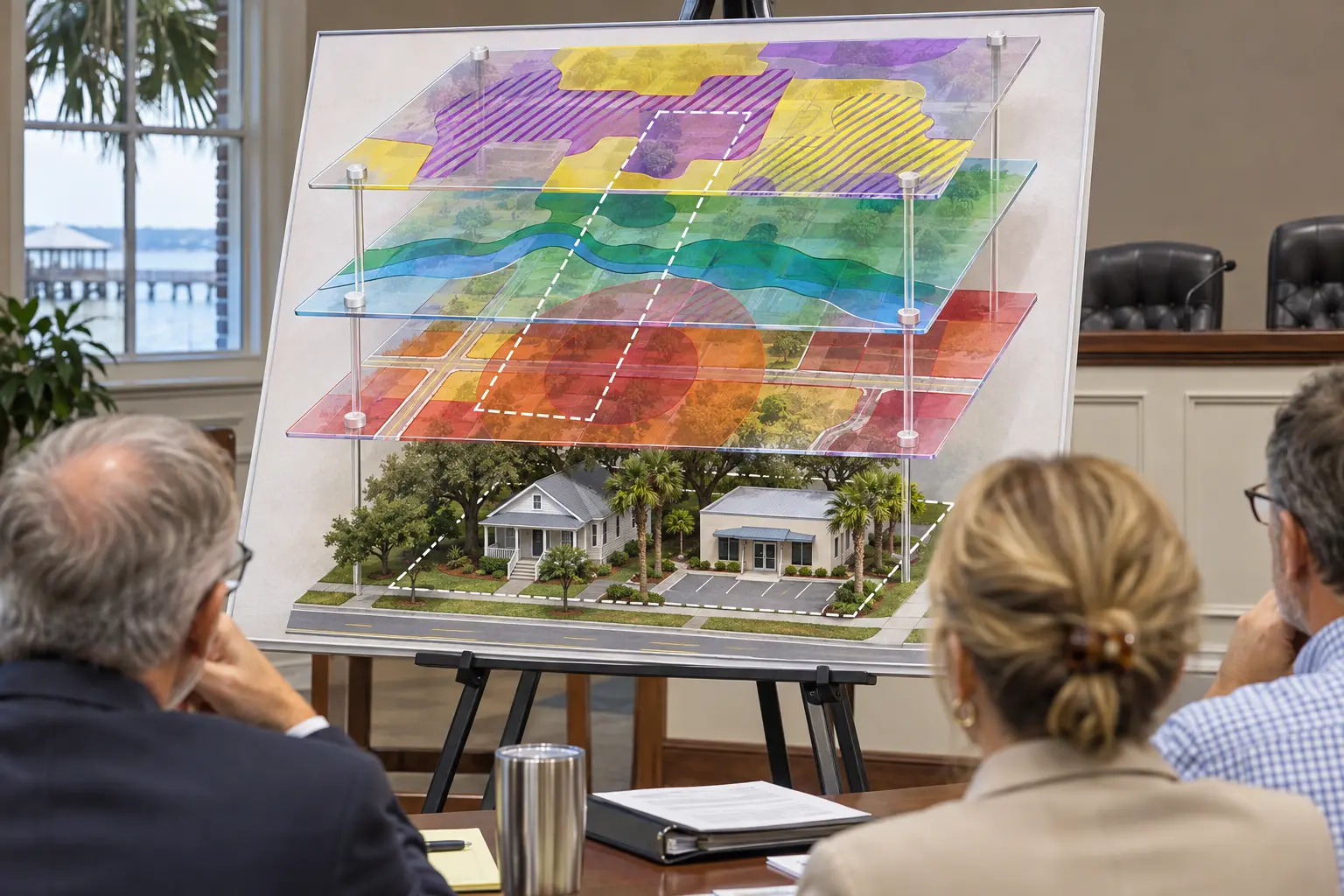
Layers demonstrated the change using three transparent maps stacked above a miniature model of the property. The first showed the underlying zoning. The second showed the overlay zoning. The third showed what residents reasonably assumed the first two maps meant.
When the sheets were aligned, the parcel disappeared entirely beneath purple crosshatching.
Another layer brings clarity
Under the fictional explanation, underlying zoning describes what the property is. Overlay zoning describes what it may do. The new zoning describes what it may continue doing after a public hearing.
The proposed business category ordinarily includes general office use, but that use would remain prohibited, ensuring the rezoning gains a use that it immediately promises not to use.
“That is how you know the ordinance is tailored,” Layers said. “A standard rezoning gives you more options. A careful rezoning gives you options and then removes the one everybody noticed.”
Commissioners asked whether the existing medical overlay could simply continue governing the medical uses it already governed.
Staff responded that it could, but doing so would fail to resolve the important administrative question of whether the same outcome might look more intentional under a different color on the map.
Residents receive decoder cards
Neighbors attending the fictional hearing were issued laminated decoder cards listing every zoning layer within 300 feet.
The cards included underlying zoning, medical overlay zoning, comprehensive-plan designation, future-land-use aspiration, conditional-use memory and the informal category known as “that building has been there forever.”
Northrop Avenue resident Ellen Boundary said she supported medical uses but wanted to understand which rule allowed them.
“Apparently all of them, collectively, except individually,” Boundary said. “I asked whether the property was residential or business, and they gave me a small transparent sheet.”
Officials assured residents that the rezoning would create no new confusion. Any confusion generated by the new ordinance would merely replace confusion already permitted by the overlay.
Map achieves total transparency
The city’s fictional Department of Layered Certainty said the new map display would become standard at future zoning hearings.
Applicants will place each regulation on a separate acrylic panel and keep adding panels until the requested use can no longer be seen from the audience.
Projects obscured by at least four layers will be deemed “administratively compatible.” Projects still visible after six layers must provide additional landscaping.
“Our goal is complete transparency,” Layers said, standing behind a stack of maps too opaque to see through. “We believe we have achieved it.”
The department is also developing an interactive online map. Users will be able to enter an address and receive a message explaining that the answer depends on which map they intended to ask about.
Clarification approved
At the close of the fictional hearing, officials approved the change and prohibited general office use.
The property may now pursue most of the medical uses it could pursue before, subject to the business standards that already applied and the new business designation created to confirm that they applied.
Residents were told the action would simplify future applications.
Instead of explaining why a medical use is allowed by an overlay on residential property, applicants may now explain why a general office is not allowed on business property.
At press time, the city was considering an overlay to clarify the rezoning that clarified the overlay.